
Blog
International Day of the Girl Child

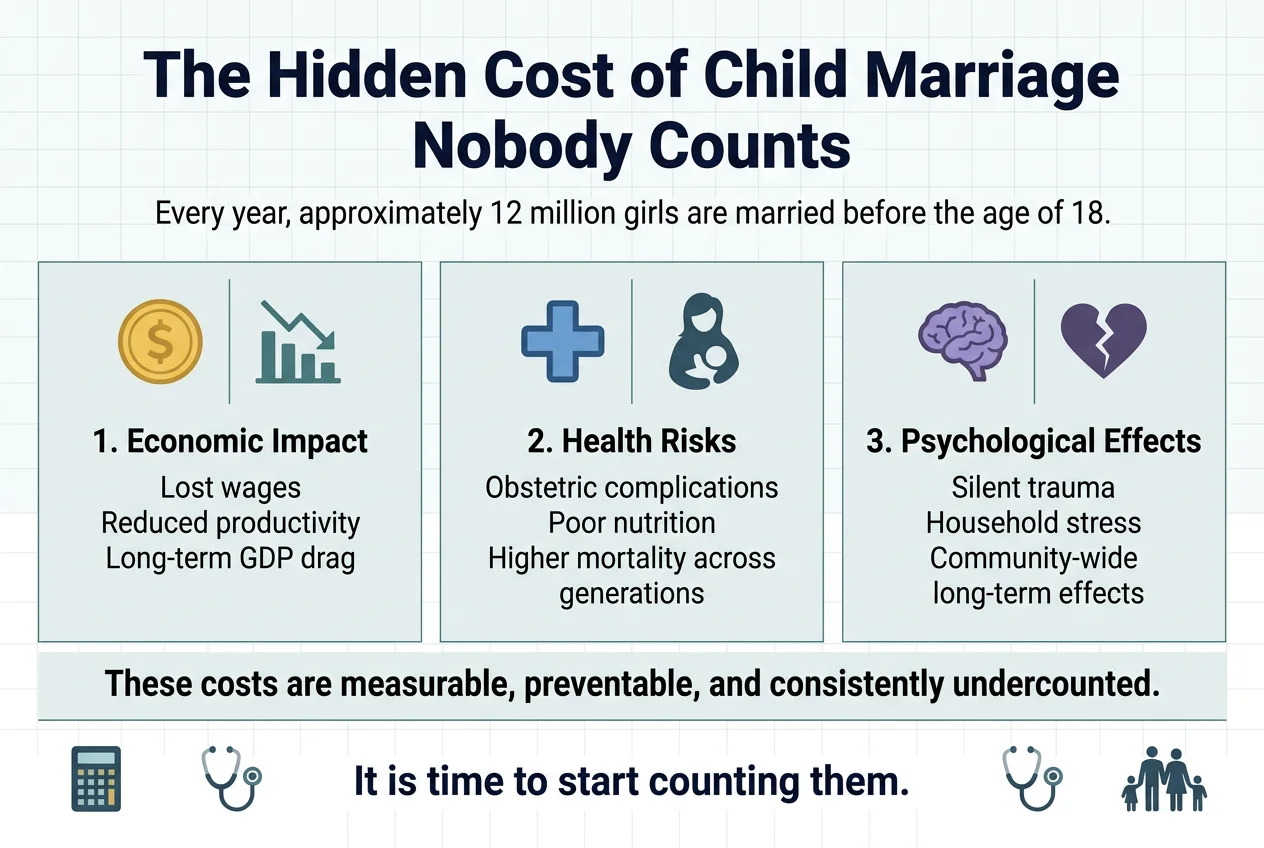
The Hidden Cost of Child Marriage Nobody Counts
Every year, approximately 12 million girls are married before the age of 18. That number gets cited often. What rarely gets cited is everything that happens after.
This piece is for policymakers, educators, advocates, development professionals, and anyone who wants to understand why ending child marriage is not just a human rights issue — it is an economic, public health, and community development issue all at once. The conversation around child marriage statistics tends to stop at the numbers. This one starts there.
On the International Day of the Girl Child, this year’s theme — End child marriage and invest in girls’ rights — puts the spotlight exactly where it belongs. But slogans only go so far without a clear picture of what these costs actually look like on the ground.
Here is what gets covered:
- The economic impact of child marriage that never shows up in national budgets, including lost wages, reduced productivity, and long-term GDP drag
- The child bride health risks that ripple outward — from obstetric complications to generational cycles of poor nutrition and mortality
- The psychological effects of child marriage that girls carry quietly, and the way those effects shape entire households and communities for decades
The long-term effects of early marriage are not abstract. They are measurable, preventable, and consistently undercounted. It is time to start counting them.
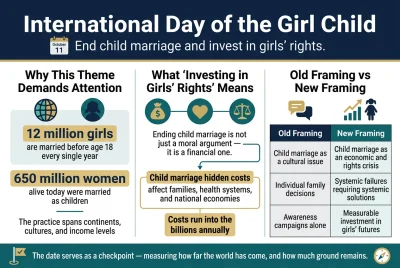
Every year on October 11th, the world marks International Day of the Girl Child. The 2026 theme — “End child marriage and invest in girls’ rights” — cuts straight to one of the most persistent yet overlooked crises affecting girls globally.
Why This Theme Demands Attention
Child marriage remains shockingly common. Around the world:
- 12 million girls are married before age 18 every single year
- Over 650 million women alive today were married as children
- The practice spans continents, cultures, and income levels
What “Investing in Girls’ Rights” Actually Means
The theme carries a deliberate economic framing. Ending child marriage is not just a moral argument — it is a financial one. The child marriage hidden costs absorbed by families, health systems, and national economies run into the billions annually, yet rarely appear in policy budgets or development reports.
Choosing this theme signals a shift in global conversation:
| Old Framing | New Framing |
| Child marriage as a cultural issue | Child marriage as an economic and rights crisis |
| Individual family decisions | Systemic failures requiring systemic solutions |
| Awareness campaigns alone | Measurable investment in girls’ futures |
The date serves as a checkpoint — measuring how far the world has come, and how much ground remains.
Grasping the Full Impact of Child Marriage
How Child Marriage Is Defined and Measured Globally
Child marriage refers to any formal or informal union in which one or both parties are under 18 years old. Globally, organizations like UNICEF track child marriage statistics through household surveys, including the Demographic and Health Surveys (DHS) and Multiple Indicator Cluster Surveys (MICS).
Why Official Statistics Fail to Capture the Full Picture
Official child marriage statistics consistently undercount the real numbers because:
- Informal unions go unregistered and unrecorded
- Birth registration gaps make age verification impossible in many regions
- Stigma and fear discourage families from accurate reporting
- Cultural normalisation means many communities don’t identify early marriage as a problem worth reporting
Many girls living as child brides never appear in any official database, making the long-term effects of early marriage nearly invisible to policymakers.
The Regions and Communities Most Affected
| Region | Prevalence |
| Sub-Saharan Africa | Highest absolute numbers |
| South Asia | Highest regional rates historically |
| Latin America & Caribbean | Stagnating progress |
| Middle East & North Africa | Significant underreporting |
Rural poverty, conflict zones, and communities with limited girls’ education access consistently show the highest rates, cutting across cultural and religious lines worldwide.
The Economic Costs That Never Make Headlines
Lost Lifetime Earnings of Girls Forced Into Early Marriage
When a girl leaves school to marry, her earning potential doesn’t just shrink — it nearly disappears. Research shows that child brides earn significantly less over their lifetimes compared to women who marry as adults. The World Bank estimates child marriage costs countries billions annually in lost human capital.
The Burden Placed on National Healthcare Systems
The economic impact of child marriage extends deep into healthcare budgets:
- Obstetric complications from adolescent pregnancies require costly emergency interventions
- Higher maternal and infant mortality rates demand sustained medical resources
- Mental health conditions linked to early marriage create long-term treatment demands
These child bride health risks translate directly into measurable public expenditure.
Reduced Workforce Productivity Across Generations
Child marriage doesn’t damage just one generation’s productivity — it ripples forward. Daughters of child brides are more likely to repeat the same pattern, creating a compounding workforce gap that weakens national economic output decade after decade.
How Poverty Cycles Are Reinforced and Deepened
| Factor | Short-Term Impact | Long-Term Consequence |
| School dropout | No qualifications | Lifetime low income |
| Early pregnancy | Immediate costs | Larger, poorer families |
| Limited employment | Household poverty | Intergenerational deprivation |
Ending child marriage isn’t charity — it’s sound economic policy.
The Devastating Toll on Physical Health
Dangers of Early Pregnancy and Childbirth Complications
Child bride health risks begin the moment pregnancy occurs. Girls under 18 — often under 15 — carry pregnancies in bodies that are physically unready. Their pelvises haven’t fully developed, making obstructed labor extremely common. Obstetric fistula, a devastating birth injury causing chronic incontinence and social isolation, affects young brides at disproportionately high rates globally.
Higher Maternal and Infant Mortality Rates Among Young Brides
The child marriage statistics on maternal death tell a stark story:
| Age Group | Maternal Mortality Risk |
| Girls under 15 | 5x higher than women in their 20s |
| Girls 15–19 | 2x higher than women aged 20–24 |
| Newborns of young mothers | 60% higher infant mortality rate |
These numbers represent preventable deaths — losses that never appear in economic analyses of child marriage consequences.
Long-Term Reproductive Health Consequences Rarely Discussed
Beyond childbirth, the long-term effects of early marriage on physical health include:
- Chronic pelvic pain from repeated early pregnancies
- Higher cervical cancer rates linked to early sexual activity
- Nutritional deficiencies that persist decades after marriage
- Reduced access to reproductive healthcare, compounding existing damage over a lifetime.
The Psychological Price Girls Pay in Silence
Trauma, Depression, and Anxiety Linked to Early Marriage
The psychological effects of child marriage run deep and are rarely documented. Girls forced into early marriage frequently experience acute trauma responses, chronic depression, and debilitating anxiety. Removed from familiar environments and placed under spousal authority, many develop PTSD symptoms that persist well into adulthood.
Loss of Identity and Autonomy in Formative Years
Adolescence is when identity takes shape. Child marriage cuts that process short. Girls transition abruptly from childhood into roles of wife and mother, leaving no space for self-discovery, personal ambition, or independent thought. The long-term effects of early marriage on identity formation are profound and largely irreversible.
The Lasting Impact on Self-Worth and Mental Wellbeing
Years of suppressed voice and constrained choices erode self-worth quietly. Research consistently links child marriage to lower self-esteem, diminished agency, and higher rates of suicidal ideation compared to women who married as adults.
Barriers That Prevent Girls from Seeking Mental Health Support
Child brides face compounded barriers to mental health care:
- Social stigma around mental illness in many communities
- Financial dependence on spouses who control resources
- Geographic isolation from healthcare facilities
- Lack of awareness that what they experience is treatable
These barriers ensure the psychological price girls pay stays hidden, uncounted, and unaddressed.
The Educational Opportunities Lost Forever
How Marriage Forces Girls Out of School Prematurely
Child marriage and education rarely coexist. Once a girl is married, household responsibilities, pregnancy, and social expectations pull her away from classrooms permanently. Schools often enforce dropout policies for married students, making re-entry nearly impossible. The long-term effects of early marriage on education remain severely undercounted in national development data.
The Ripple Effect on Community Literacy and Development
When girls leave school early, entire communities absorb the loss:
- Lower literacy rates reduce civic participation and economic productivity
- Reduced female workforce participation shrinks local economies
- Generational cycles of low educational attainment repeat, as uneducated mothers statistically raise children with lower school completion rates
- Public health literacy declines, affecting community-wide health outcomes
Research consistently shows that one additional year of secondary schooling increases a girl’s future earnings by 10–20%.
Skills and Potential That the World Never Gets to See
Child marriage statistics rarely capture what disappears alongside dropout rates — scientists, teachers, engineers, and leaders whose potential never surfaces. Each girl removed from education represents not just personal loss but a measurable gap in innovation, leadership, and problem-solving capacity that communities, businesses, and governments urgently need. Ending child marriage is fundamentally an investment in human capital the world cannot afford to waste.
Hidden Social Costs Borne by Entire Communities
Increased Rates of Domestic Violence Within Child Marriages
Child marriages carry significantly higher rates of domestic violence than adult unions. Young girls lack the legal knowledge, financial independence, or social support to escape abusive situations, making violence a recurring, normalised feature of their daily lives.
The Generational Cycle of Marrying Daughters Young
Families that experienced child marriage often repeat the pattern across generations. Daughters raised in these households absorb the belief that early marriage is simply how life works — not a choice, but an expectation. This cycle quietly rebuilds itself without external intervention.
Weakened Social Structures and Community Resilience
Communities with high child marriage rates demonstrate measurably weaker collective resilience:
- Lower civic participation among women
- Reduced workforce diversity, limiting local economic adaptability
- Higher dependency ratios, straining shared community resources
- Decreased intergenerational social mobility
The child marriage community impact extends well beyond individual households, quietly eroding the foundations that make communities function.
How Gender Inequality Is Normalised and Passed Down
When child marriage becomes a cultural baseline, gender inequality stops feeling like injustice — it feels like tradition. Boys grow up expecting dominance; girls grow up expecting submission. Ending child marriage and investing in girls’ rights, as the International Day of the Girl Child emphasises, directly disrupts this inherited inequality before another generation absorbs it as truth.
Why These Costs Stay Hidden and Who Benefits from Silence
Cultural and Political Pressures That Suppress the Data
Governments in high-prevalence regions often face reputational pressure when child marriage statistics surface internationally. Local officials may underreport cases, delay civil registration reforms, or resist population surveys that expose uncomfortable numbers. In communities where child marriage is normalized across generations, documenting the practice feels like an attack on cultural identity — creating organized resistance to data collection efforts.
Economic Incentives That Keep Families Compliant
The child marriage hidden costs narrative rarely reaches families navigating poverty. Bride price and dowry systems create direct financial motivation, turning daughters into economic transactions. For households earning below subsistence level, marrying off a daughter reduces one mouth to feed while generating immediate income — a brutal but rational calculation when survival is the priority.
| Economic Driver | Impact on Decision-Making |
| Bride price payments | Immediate cash for impoverished families |
| Reduced household expenses | One fewer dependent to support |
| Debt settlements | Daughters used to clear financial obligations |
The Role of Weak Legal Systems in Enabling the Practice
Where legal frameworks around child marriage exist only on paper, enforcement collapses entirely. Corrupt local officials, absent birth registration systems, and courts inaccessible to rural communities create enormous gaps. Without meaningful accountability, ending child marriage remains aspirational rather than actionable.
Practical Steps to Start Counting What Truly Matters
Improving Data Collection Methods to Reveal Hidden Costs
Current child marriage statistics barely scratch the surface. Stronger data systems need to:
- Track lifetime earnings loss for girls who leave school early
- Record healthcare expenditures tied to early pregnancy complications
- Measure productivity gaps in communities with high child marriage rates
- Document psychological treatment costs that families absorb quietly
Standardised national surveys should embed child marriage indicators alongside economic and health metrics, making the long-term effects of early marriage impossible to overlook.
Empowering Local Organizations to Document Real Impact
Grassroots organizations sit closest to the truth. Investing in their capacity to collect, verify, and report data transforms isolated stories into powerful evidence. Training community health workers, women’s groups, and local NGOs to document child bride health risks and educational losses creates a reliable pipeline of ground-level insight that national governments rarely capture alone.
Holding Governments Accountable Through Transparent Reporting
On International Day of the Girl Child, the call to “End child marriage and invest in girls’ rights” demands measurable commitments, not just declarations. Accountability mechanisms should include:
- Annual public reports linking child marriage rates to national economic indicators
- Independent audits of government spending on girls’ education and protection programs
- Civil society review panels with real authority to challenge incomplete reporting
Conclusion
Child marriage carries a price tag far heavier than what gets recorded in any official report. The economic losses, broken health outcomes, stolen education, deep psychological wounds, and the ripple effects felt across entire communities all add up to a staggering cost that rarely gets the attention it deserves. These hidden costs stay buried not because they are small, but because the systems and structures that should be counting them often benefit from the silence.
On the International Day of the Girl Child, the call to end child marriage and invest in girls’ rights is not just a campaign slogan — it is a demand for accountability. Every girl pulled out of school and into an early marriage represents a future that gets quietly erased from the count. Choosing to start measuring what truly matters, from mental health to lost lifetime earnings to community-wide setbacks, is the first real step toward ending a practice that costs everyone far more than is ever admitted.